I have a question for you: what did you want to be when you grew up?
Maybe it was a firefighter or a pilot; a basketball or hockey player; perhaps a doctor or a teacher or a parent.
But regardless of what your unique dreams were for the future, increasing research has shown that it is very difficult for us to dream of things when we can’t see ourselves already represented in those places. Think of the following realities:
- It’s easier, for example, for little girls to dream of being doctors today than it was even 50 years ago in Canada (just 7% of doctors were female in 1970 vs. 40% today).
- It’s easier (though still incredibly difficult) for people of colour to dream of holding high office in the US after Barack Obama was President for eight years than it was before 2008.
- It’s easier for little girls to dream of being hockey players in Canada after the Canadian Women’s Hockey Team won 24-consecutive Olympic hockey games, taking home the gold medals for 2002, 2006, 2010 and 2014 with silver medal finishes in 1998 and 2018.
- It’s even easier for men to choose to be stay-at-home dads the more they have the chance to see other men making the same choice.
In each and every case listed above, there were trailblazers. People who were able to have the vision and the courage and the support to be willing to reach out and try for things that no one had done before.
Eventually, with enough trailblazers and representation people start to catch on to this. My mother’s Barbies from the 1950’s included a ‘nurses’ uniform, but the ‘Barbie Careers’ line now includes a ‘Pet Vet‘ and a ‘Baby Doctor‘. Mattel also has a ‘Fashionista‘ line of Barbies with different skin tones, and although they have had some backlash about how long it took and exactly how they have styled the dolls, the fact that they and others have picked up on the need for dolls that little girls can relate to in terms of skin tone and professional ambitions are huge breakthroughs in terms of representation.
Unfortunately, the road to representation is still lagging considerably for those with disabilities. When Mattel brought out a ‘Wheelchair Barbie’ back in 1997, people were ecstatic – until they realized that Mattel had completely failed to make sure that Wheelchair Barbie fit in the Barbie house or elevator. And, instead of taking the lead and creating a universally designed home for Barbie and her friends, their response was to take “wheelchair Barbie” off the shelves.
ABC is currently breaking huge ground with their show ‘Speechless’ which features a primary character with Cerebral Palsy, played by a character with Cerebral Palsy, but other shows, such as Netflix’ ‘Atypical’ still routinely hire able-bodied actors to play disabled characters.
The world of athletics is no better. Although the Paralympics have been running since 1960, television coverage of the events are still not readily accessible to all. And with a slight blip of improvement at the 2012 London Games, as recently as the 2018 games this year I have struggled to get good internet coverage of the Paralympic events.
But last weekend was a little bit different.
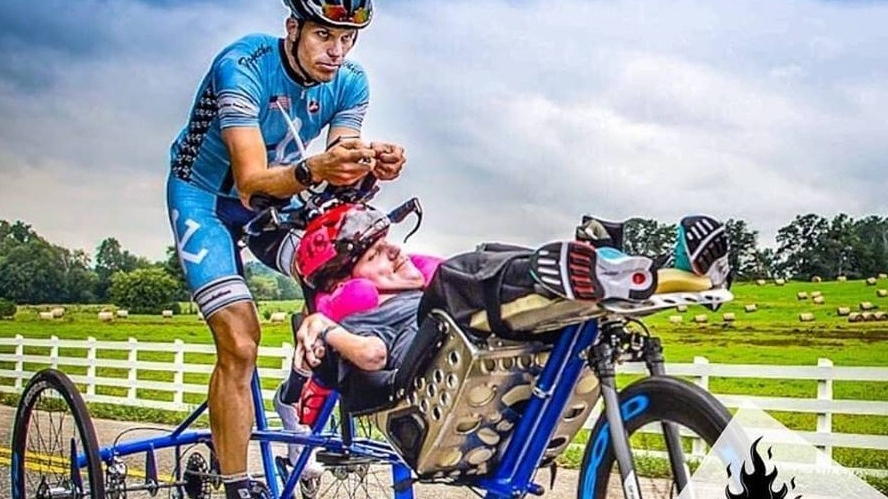
In honour of their 40th anniversary, the Ironman association decided to offer an Ambassador place to Brent and Kyle Pease, brothers who run #accessibletriathlon. These brothers were the second accessible team ever to participate in the Ironman World Championships at Kona, and I spent the day on the edge of my seat cheering for a sports event in a way that I have rarely had the chance to cheer before.
For one simple reason: I can imagine a world where that could be Trevor and I.
Now, it doesn’t mean that we will choose to put in the time and effort necessary to get to that level. It doesn’t mean that we won’t have an injury or illness that will prevent us from getting to that level. It doesn’t mean that we will have the same kinds of supports or opportunities as they had to get to that level. But the fact is that if they can do it, so could we!
And all of a sudden I’m dreaming again. I’m wondering what the next step might be for us in our #accessibleracing career.
All of a sudden I’ve got a model to follow. I can see that it took them seven years to get from their first race to the Ironman, so it’s okay if the process takes some time.
All of a sudden I have some stats to compare ourselves too. They completed the bike leg of the Ironman at approximately the same speed as we bike our little 20k distance at – so we just have to be able to repeat that eight more times and we’ll have it!
That is the difference that representation makes. That is the difference that trailblazers like the Pease brothers make.
These things matter, because these are the things that dreams are made of!
So a big hats off to all the trailblazers out there who are making a difference. Who are making the world more accessible for folks who would otherwise be missing out.
And a huge encouragement to all those working with, connecting with, caring for or experiencing disabilities themselves to go looking for the heroes that you uniquely need – writers, athletes, actors, professionals, community organizers, whoever it might be – and then spend time celebrating and highlighting those people in your everyday life. Because these acts may just be the seeds someone needs to grow their dreams!

 Powered by Love
Leave a comment