
So what exactly does it mean for us to compete in a race like this?
Usually during running races the accommodations are quite simple: I’m allowed to use my chair, and often the race director (if we’re lucky) will allow us to start at the front of the race, enabling able-bodied athletes to go around us instead of the other way around.
But with a swim and a bike and a run there is a bit more accommodating to be navigated!
The first accommodation is obviously the dinghy. I will not be swimming, I will be in the raft and will be being towed behind Trevor. This raises some safety concerns in terms of the rope getting caught up in other swimmers, or the boat going over other people as they swim. The race director had initially suggested that we start at the end of the race, but after a fabulously encouraging message from Jeff Agar – who cited instances where his boat was mistakenly assumed to be a life boat and where weak swimmers had grabbed on when they were struggling, placing the team and the struggling swimmers at risk – we have been able to get that changed as well. As of last week, we found out that we have permission to start just ahead of the first pack of swimmers! Although some will almost certainly overtake us, this will make things much safer for us, and mean that we’re not still out on the course ages after everyone else finishes!
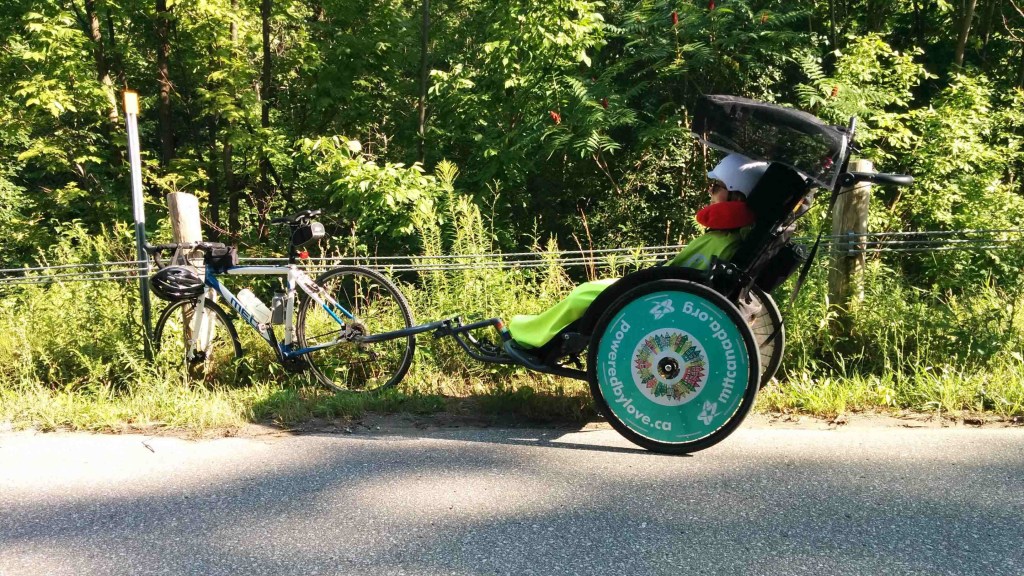
The second accommodation is that we will need a larger-than-average space in transition. My chair + Trevor’s bike + separate attachments + helmets + space to get me in and out of the chair will take up a much higher-than-average space in the transition zone, so we are fortunate to be working with a race that has ample space in transition. They will be setting aside an area as close to the swim exit as possible, and we are still deciding whether Trevor will run me to the chair, or whether we will use my wheelchair for the transfer.
Either way, the third accommodation we have is a couple of dedicated volunteers for our race. These two wonderful humans will be on hand to take my wheelchair from me at the water’s edge as we enter to begin the race. They will also be there to take the dinghy back from us, and to help with making sure nothing gets missed or is unsafe during the transition zones. I am so thankful for these folks!
If you’re having trouble visualizing all of this, I would really encourage you to take a look at the amazing video that our friends at Five Points Media have put together for us. They will also be present at the Barrie Triathlon to record our race, and we’re hoping to work with them over the next several months to create a ‘how-to’ series for other aspiring accessible triathletes, as there is very little in the way of resources available for athletes such as ourselves.
We are hoping to raise some money and awareness around accessible racing with our work, to make it possible for more folks with disabilities to get out and participate. If you’re interested in helping to support this cause, please visit my GoFundMe page!

 Powered by Love
Leave a comment